![[Jupiter quilt]](jupiter.jpg)
This page last updated Oct 6 2020.To email me, see see my ordering Web page for my email addresses.
I was an active amateur astronomer in the 1990's. This page shows some of the things I've done, places I've visited to observe, and some of the local astronomy clubs I've been associated with. I also have some equipment to sell.
About the quilt: As my wife is a quilter, she convinced me to make a "simple" quilt in May 1999. I saw Jupiter,
with its pastel bands in a black sky, as a good subject. This quilt measures about 13 inches
square (the apparent short side is the camera's fault). My wife was pleased enough with the result that she showed it with her quilts at a local show of her quilt guild. The members thought it was a "great first effort".
My astronomy activities::
I have a number of astronomical items for sale, including some 6-inch and 8-inch thin blanks. Read about the blanks here. and here's a Web page with specific optical items.
I have some astronmonical and astrophysics books too.
![[telescope]](/glass/edmund_boxopen.jpg) mid-1960's Edmund Scientific Space Conqueror, 3" reflecting telescope, with tripod and finder scope, original documents, in original box. This was sold in 2016, but the Web page
has a good description of the product.
mid-1960's Edmund Scientific Space Conqueror, 3" reflecting telescope, with tripod and finder scope, original documents, in original box. This was sold in 2016, but the Web page
has a good description of the product.
![[CCD Camera]](ccd.jpg) I built this digital CCD camera in 1995 for astronomical use, and I
sold it a few years later. Thousands
of amateur astronomers have built this model, offered as a book and circuit
boards and a kit of parts.
I built this digital CCD camera in 1995 for astronomical use, and I
sold it a few years later. Thousands
of amateur astronomers have built this model, offered as a book and circuit
boards and a kit of parts.
![[GEM mount and Herb]](herbmtx.jpg) Here's my German Equitorial Mount (GEM) and I'm standing next to it.
This mount of brass and iron pipe was built in NJ, probably in the 1970's,
and was previously owned by various organizations in Princeton.
In 1998-99 I found an engineer, Jerry Avins, to help me restore the GEM.
He cut a Delrin worm gear to drive the larger gear, which moves the mount
to follow the apparent motion of the sky). And Jerry's set up the worm on a
prototype platform with drive shaft and stepper motor!
He and I designed the drive mechanics and some of the electronics to drive the stepper.
I have an old 8-inch telescope to put on the mount, built in the 1930's.
Eventually I'll either mount that tube on the mount, or I'll build something
from my 12.5 inch f/7 mirror as a new telescope.
Here's my German Equitorial Mount (GEM) and I'm standing next to it.
This mount of brass and iron pipe was built in NJ, probably in the 1970's,
and was previously owned by various organizations in Princeton.
In 1998-99 I found an engineer, Jerry Avins, to help me restore the GEM.
He cut a Delrin worm gear to drive the larger gear, which moves the mount
to follow the apparent motion of the sky). And Jerry's set up the worm on a
prototype platform with drive shaft and stepper motor!
He and I designed the drive mechanics and some of the electronics to drive the stepper.
I have an old 8-inch telescope to put on the mount, built in the 1930's.
Eventually I'll either mount that tube on the mount, or I'll build something
from my 12.5 inch f/7 mirror as a new telescope.![[meteorite]](gibeon.jpg) At the 1999 Rockland Astronomy Forum, I bought this bit of Gibeon meteorite. It
weighs about 18 grams. The black area is the outside crust, with a little
thumb-sized depression due to ablation during its fall. The edges
are sharp and flat from cutting. Another photo shows the
Widmanstatten pattern of fine crystalline line structure,
revealed with an acid etch: a clear indication this is meteoric material.
This is part of 18 tons of meteoric material recovered in the 1990's,
from an old fall in Namibia. Pieces up to 1400 lbs in weight were recovered.
At the 1999 Rockland Astronomy Forum, I bought this bit of Gibeon meteorite. It
weighs about 18 grams. The black area is the outside crust, with a little
thumb-sized depression due to ablation during its fall. The edges
are sharp and flat from cutting. Another photo shows the
Widmanstatten pattern of fine crystalline line structure,
revealed with an acid etch: a clear indication this is meteoric material.
This is part of 18 tons of meteoric material recovered in the 1990's,
from an old fall in Namibia. Pieces up to 1400 lbs in weight were recovered.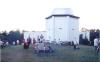 The New Jersey Astronomical Association (NJAA) has been around for over 40 years.
It has an observatory with a 26-inch telescope and dome, and a public meeting
and storage facility, at Vorhees State park in High Bridge NJ. I was a member for several years. I rebuilt some
telescopes and a 1940's lathe. The NJAA Web site is at
http://www.njaa.org.
The New Jersey Astronomical Association (NJAA) has been around for over 40 years.
It has an observatory with a 26-inch telescope and dome, and a public meeting
and storage facility, at Vorhees State park in High Bridge NJ. I was a member for several years. I rebuilt some
telescopes and a 1940's lathe. The NJAA Web site is at
http://www.njaa.org.
![[AAAP Obs.]](lxobs5.jpg) Here's a 1998 interior shot of the Amateur Astronomical
Association of Princeton's
Simpson Observatory at a nearby state park just outside of Trenton NJ.
Several club members are preparing the Observatory for winter operation.I was a member for several years.
The telescope in the back is a 12.5 inch f/6 reflector (big mirror). (This scope
is now at their new observatory in northern New Jersey. It was replaced with
a Celestron C-14 and a Software Bisque mount.) The foreground
telescope is a Hastings-Byrne 6-inch refractor (6-inch lens) that was built in the 1880's.
Despite the flaky paint it is a good telescope, used in its time for critical
observations of the Sun. (The original mount as pictured was replaced a few years ago, and the refractor tube replaced, and it is still in operation today.) A Web site for the AAAP is
http://www.princetonastronomy.org/ .
Here's a 1998 interior shot of the Amateur Astronomical
Association of Princeton's
Simpson Observatory at a nearby state park just outside of Trenton NJ.
Several club members are preparing the Observatory for winter operation.I was a member for several years.
The telescope in the back is a 12.5 inch f/6 reflector (big mirror). (This scope
is now at their new observatory in northern New Jersey. It was replaced with
a Celestron C-14 and a Software Bisque mount.) The foreground
telescope is a Hastings-Byrne 6-inch refractor (6-inch lens) that was built in the 1880's.
Despite the flaky paint it is a good telescope, used in its time for critical
observations of the Sun. (The original mount as pictured was replaced a few years ago, and the refractor tube replaced, and it is still in operation today.) A Web site for the AAAP is
http://www.princetonastronomy.org/ .
 From 2003-2006, I attended meetings of the ATM (amateur telescope making)
group of the STAR astronomy club, which meets
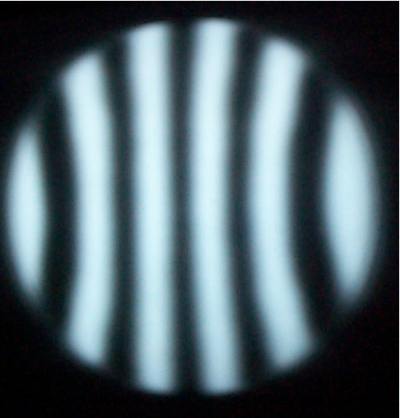
in south New Jersey. Their ATM group met at Gordon Waite's facilities during that period. Check their Web site for details. In 2003-04 I figured an 8-inch mirror there. In 2005-06 I ground a mirror there from scatch.
From 2003-2006, I attended meetings of the ATM (amateur telescope making)
group of the STAR astronomy club, which meets
in south New Jersey. Their ATM group met at Gordon Waite's facilities during that period. Check their Web site for details. In 2003-04 I figured an 8-inch mirror there. In 2005-06 I ground a mirror there from scatch.
Tom Droege died in Feb 2008, active in the survey and in development almost to the last. As of August 2008 it's not clear what the future of the TASS survey will be. Active Web sites include Michael Sallman's database site, part of the TASS site run by Michael Richmond at RIT. As of April 2009, Michael is still "building" a terabyte server to hold Tom's old data. Read his 2008 status report here.
In support of the Mark IV, in Nov 1999 I did some dark current analysis of Mark IV image files from Tom's #5 CD-ROM, distributed in late Oct 1999 by Tom. I also analysed coma and saturation in the early Mark IV disk #5 images. (That coma went away when they properly re-assembled their lens system.) I also chronicled their discussions of data compression of TASS star images, archiving devices for TASS star images, and discussions of Mark III time references and VCO rates.
One of my more comprehensive Tech Notes was #57, on Mark III sites and databases. It is a compliation of information about the Mark III cameras: who had them, who used them, what software they used, and what they did with the data. There are Web pointers to the host sites for each camera. I consider this a very useful Tech Note for anyone trying to make sense of what TASS was all about in that era. Other Tech notes from that period describe what was done with the data collected at that time. My involvement was primarily with the Mark III and early Mark IV development. I have a broken Mark III camera - one of the few not destroyed by time or weather! As of 2001 I became inactive in TASS.
See the TASS Web page at http://www.tass-survey.org , and work your way over to the "technical section" and then to the "TASS Tech Notes" to see the many TN's submitted by my TASS colleagues and myself.
![[Orion Nebula]](lorion2.jpg) In 1998 I evaluated the Orion finder telescope, as a test optic for a CCD camera under
development for TASS. I used the 12.5 inch telescope of the AAAP
to guide my 35mm Nikon FG camera and an Orion 400mm f/5 telescope for this 4-minute
exposure of the Orion Nebula, using Kodak MAX (800 speed color) film. The photo was taken about
an hour after sunset, 7PM -7:30PM on March 16th 1998 with Orion near the
meridian at about 45 degrees altitude. Here's some notes about how I did this.
In 1998 I evaluated the Orion finder telescope, as a test optic for a CCD camera under
development for TASS. I used the 12.5 inch telescope of the AAAP
to guide my 35mm Nikon FG camera and an Orion 400mm f/5 telescope for this 4-minute
exposure of the Orion Nebula, using Kodak MAX (800 speed color) film. The photo was taken about
an hour after sunset, 7PM -7:30PM on March 16th 1998 with Orion near the
meridian at about 45 degrees altitude. Here's some notes about how I did this.